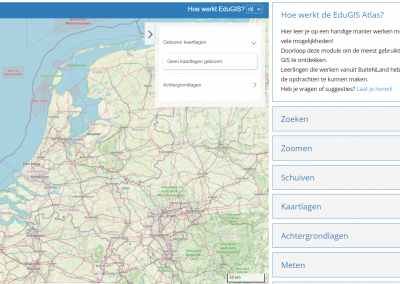









In the new edition of buiteNLand, EduGIS is used in the chapter on the topic of carrying capacity for second year vmbo and havo/vwo.
Print version (pdf)
|
HET MILIEU IN NEDERLAND
|

|
Zoom out until you're at the scale level for the whole of the Netherlands. This means that you have a map on which you can see the whole of the Netherlands. |
|
Click on Add a layer to the map. (Voeg een laag aan de kaart toe) |
| |
Choose the category Environment (Milieu) |
| |
|
| 1a |
What is smog? |
| |
(look this up, if you don't know what it is) |
| 1b |
What materials / gasses does smog consist of? |
<< Vorige 2/15 Volgende >>
-
|
Set the map layer 'Nitrogen concentration' back to 0% transparency. |
 |
Make the traffic map layer (temporarily) invisible.
|
| |
|
| 1c |
Is the traffic (motorway system) pattern still visible on the map showing the nitrogen concentration in the air? Explain your answer. |
<< Vorige 4/15 Volgende >>
| - |
Click on Add a layer to the map. (Voeg een laag aan de kaart toe) |
| - |
Choose the category Land use (Ruimtegebruik then choose Percentage of agriculture (Percentage landbouw). |
| - |
Switch map layers a couple of times and look at the patterns on the maps. If necessary, change the level of transparency of the map layers. |
| |
|
| 1d |
Is the pattern for 'Percentage of agriculture' still visible on the map for nitrogen dioxide concentration in the air? Use the north of the Netherlands to explain your answer. |
<< Vorige 5/15 Volgende >>
| - |
Click on Add a layer to the map. (Voeg een laag aan de kaart toe). |
| - |
Choose the category Environment then choose nitrogen deposits (stikstofdepositie). |
| - |
Also choose the Traffic layer. |
| - |
Switch map layers a couple of times and look at the patterns on the maps. If necessary, change the level of transparency of the map layers. |
| |
|
| 1e |
Is the traffic (motorway system) pattern still visible on the map showing nitrogen deposits? Explain your answer. |
<< Vorige 6/15 Volgende >>
|
Close the Traffic map layer. |
| - |
Click on Add a layer to the map. |
| - |
Choose the category Agriculture then choose Livestock per km2 (veestapel per km2) |
| |
Switch map layers a couple of times and look at the patterns on the maps. If necessary, change the level of transparency of the map layers. |
| |
|
| 1f |
Is the pattern for livestock per km2 still visible on the map for nitrogen deposits? Explain your answer. |
<< Vorige 7/15 Volgende >>
| - |
Click on Add a layer to the map. Choose the category Environment then choose Ammonia (Ammoniak). |
| - |
Switch map layers a couple of times and look at the patterns on the maps. |
| |
|
| 1g |
Which of the following statements are true? |
| I |
There is a spatial link between areas with concentrations of ammonia and nitrogen deposits. [true / false] |
| II |
If there is a lot of factory farming in a certain area there is a good chance that there will be high levels of ammonia deposits. [true / false] |
<< Vorige 8/15 Volgende >>
A
|
sand / potentially high acid deposits (environment) / clay (soil type) |
| B |
Rijnmond / Friesland / potentially high acid deposits |
| C |
low population density / lots of traffic / high concentration of nitrogen dioxide |
| D |
high emission of sulphur dioxide / Tilburg / IJmuiden / Rijnmond / Vlissingen |
| E |
high emissions of sulphur dioxide / Oost-Brabant / overfertilisation |
| F |
percentage agriculture / traffic / high population density |
<< Vorige 9/15 Volgende >>
3.
|
By using different map layers you have already traced a number of links. Make the right combinations in table 1 (click below). |
| |
|
| |
 |
| 2. |
|
You have seen that by applying various map layers, spatial links can be discovered. Based on your own choice of layers, you are going to decide which elements are spatially linked and which are not. To do this, you have to find the odd word out.
To help you, sometimes there is a hint in brackets with the category of the map layer. |
<< Vorige 10/15 Volgende >>
<< Vorige 11/15 Volgende >>
4 ENVIRONMENTAL RESEARCH IN YOUR OWN NEIGHBOURHOOD
It has become clear that some natural cycles are threatened in the Netherlands too. In this assignment, we are going to compare threats in your environment with the environment of somebody in your family, or someone you met on holidays somewhere else in the Netherlands.
<< Vorige 12/15 Volgende >>
The idea is that you choose an environment that is very different to yours. If you don't know anybody that lives somewhere completely different to you, you still need a noticeably different area for your research. A student from Rotterdam could compare his or her environment with somebody from the West-Frisian Islands and somebody from a village in the Peel region could compare his or her environment with somebody in the Randstad or Zeeland.
<< Vorige 13/15 Volgende >>
-
|
Print Table 2 (Click below) |
| |
 |
4a
|
Write down the names of two municipalities that you are going to compare in table 2 (next page). Use the Grote Bosatlas if necessary. |
|
For research on the damage to the environment, choose maps from the following categories: population density (bevolkingsdichtheid), soil type (grondsoort), land use (ruimtegebruik), environment (milieu) and agriculture (landbouw).
|
| |
4b
|
In the table, write down the figures given in the legend. |
<< Vorige 14/15 Volgende >>